
Bilateral Artificial Intelligence - Cluster of Excellence

The project “Bilateral AI” aims at lifting artificial intelligence (AI) to the next level. Current AI systems are in a sense narrow. They center on a specific application or task such as object or speech recognition. Our project will combine two of the most important types of AI which have been developed separately so far: symbolic and sub-symbolic AI. While symbolic AI works with clearly defined logical rules, sub-symbolic AI (such as ChatGPT) is based on training a machine with the help of large datasets to create intelligent behavior. This integration, resulting in a Broad AI, is intended to mirror something that humans do naturally: the simultaneous use of cognition and reasoning skills.
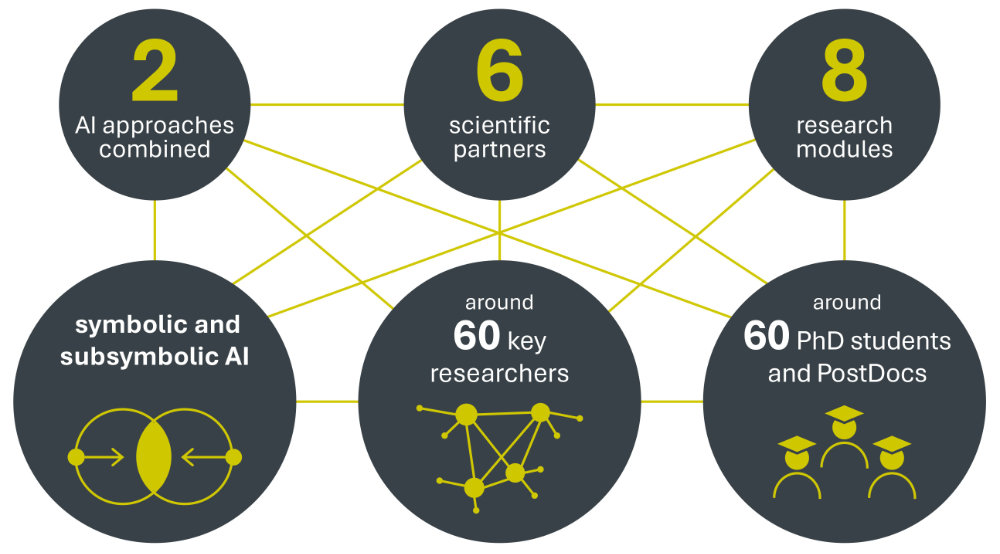
The Best of Both Worlds
But what exactly is Broad AI? As opposed to Narrow AI, which is characterized by task specific skills, Broad AI aims at solving a wide array of problems, rather than being limited to a single task or domain. By combining sub-symbolic AI (machine learning, ML) with symbolic AI (knowledge representation and reasoning, KRR), Bilateral AI provides the means to develop the foundations of a new level of AI with broader capabilities for skill acquisition and problem-solving: Broad AI. While symbolic AI works with clearly defined logical rules, sub-symbolic AI (such as ChatGPT) is based on training a machine with the help of large datasets to create intelligent behavior.
Harnessing the full potential of both symbolic and sub-symbolic approaches can open new avenues for AI that are better at solving new problems, adapting to a wide variety of environments, having better reasoning skills, and being more efficient in terms of both computation and data use. These key features allow for a vast range of use cases for Broad AI, starting with drug development and medicine, over planning and scheduling, to autonomous traffic management and recommendation systems. With fairness, transparency, and explainability as top priorities, developing Broad AI is also essential for addressing ethical concerns and ensuring a positive impact on our society.
Paving the way for this innovative approach are Thomas Eiter, Head of the Research Unit Knowledge-Based Systems (TU Wien), and Agata Ciabattoni, Head of the Research Unit Theory and Logic (TU Wien), who will provide their expertise on symbolic AI and Logics for AI within BILAI. Thomas Eiter is a leading expert in knowledge representation and reasoning (KRR), logic programming, and declarative problem-solving and will serve as the Deputy Director of Research as well as the Head of the Training Unit on the project. Agata Ciabattoni is a mathematical logician known for her work on non-classical logics and their applications and will serve on the Board of Directors of BILAI. Together with 9 key researchers across 5 different Research Units, BILAI pushes the boundaries of AI research while also providing an excellent opportunity for junior researchers and young scientists with its training unit and PhD program. Top scientists and researchers involved in the project are Robert Ganian, Georg Gottlob, Thomas Lukasiewicz, Silvia Miksch, Nysret Musliu, Magdalena Ortiz, Emmanuel Sallinger, Stefan Szeider and Stefan Woltran. Awarding this Cluster of Excellence also highlights and further strengthens the work of the Center for AI and Machine Learning (CAIML), which focuses on research activities in Artificial Intelligence and Machine Learning both in their foundations and applications, and of the Vienna Center for Logic and Algorithms (VCLA), which is dedicated to promote international research in Logic and Algorithms, as well as the training and promotion of young scientists.
Sepp Hochreiter is the Director of Research of BILAI.
Publications
|
Raphael Arthur Buchmüller, "GLANCE: Strategy-Based Visual Mediation for LLM Interaction", EuroVA workshop at EuroVis 2026, 2026. |
|
Raphael Arthur Buchmüller, Dennis Colaris, Linhao Meng, Angelos Chatzimparmpas, "LangLasso: Interactive Cluster Descriptions through LLM Explanation", VISxGenAI Workshop at the IEEE VIS Conference, 2025. |