
Explainable Dimension Reduction
Problem
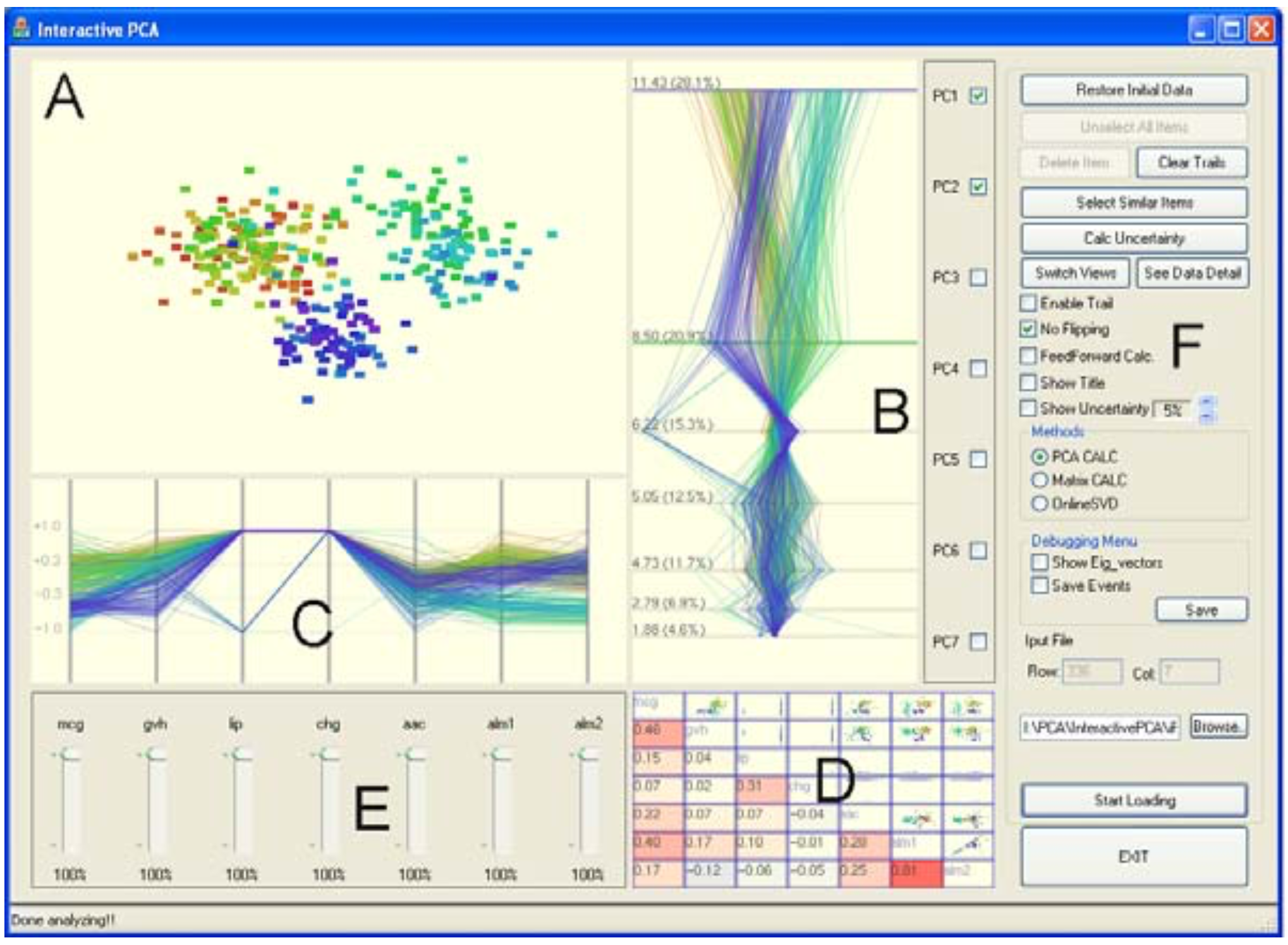
Dimension Reduction (DR) is used to analyze multidimensional tabular data, such as the often-used car dataset (https://www.kaggle.com/toramky/automobile-dataset). Synthetic dimensions are created and used to lay out observations (table rows) in a 2D scatterplot. Popular examples include Principal Component Analysis, Multidimensional Scaling, UMAP, or t-SNE.
Visualizing multidimensional data in 2D is a great advantage, but much information is also lost in that process. Other information usually associated with scatterplots just does not exist. Such information needs to be recovered, e.g.: Whether a given cluster in 2D is also truly a cluster in the multidimensional data, where boundaries of categorical dimensions are in 2D, or what the meaning of directions in 2D is.
Aim
SE: Collect and present scientific literature on explainability approaches for dimension reduction techniques.
BA/MA: Implement a DR explainability approach.
Other information
References
- M. Espadoto, R. M. Martins, A. Kerren, N. S. T. Hirata, and A. C. Telea, “Towards a Quantitative Survey of Dimension Reduction Techniques,” IEEE Transactions on Visualization and Computer Graphics, pp. 1–1, 2019, doi: 10.1109/TVCG.2019.2944182.
- L. G. Nonato and M. Aupetit, “Multidimensional Projection for Visual Analytics: Linking Techniques with Distortions, Tasks, and Layout Enrichment,” IEEE Transactions on Visualization and Computer Graphics, vol. 25, no. 8, pp. 2650–2673, Aug. 2019, doi: 10.1109/TVCG.2018.2846735.